Tyler, The Creator

Bright arrangements, private doubts.

“It's art, and an idea.”
Tyler, the Creator / GQ — Tyler, the Creator, Provocateur of the Year
Read the story ↓
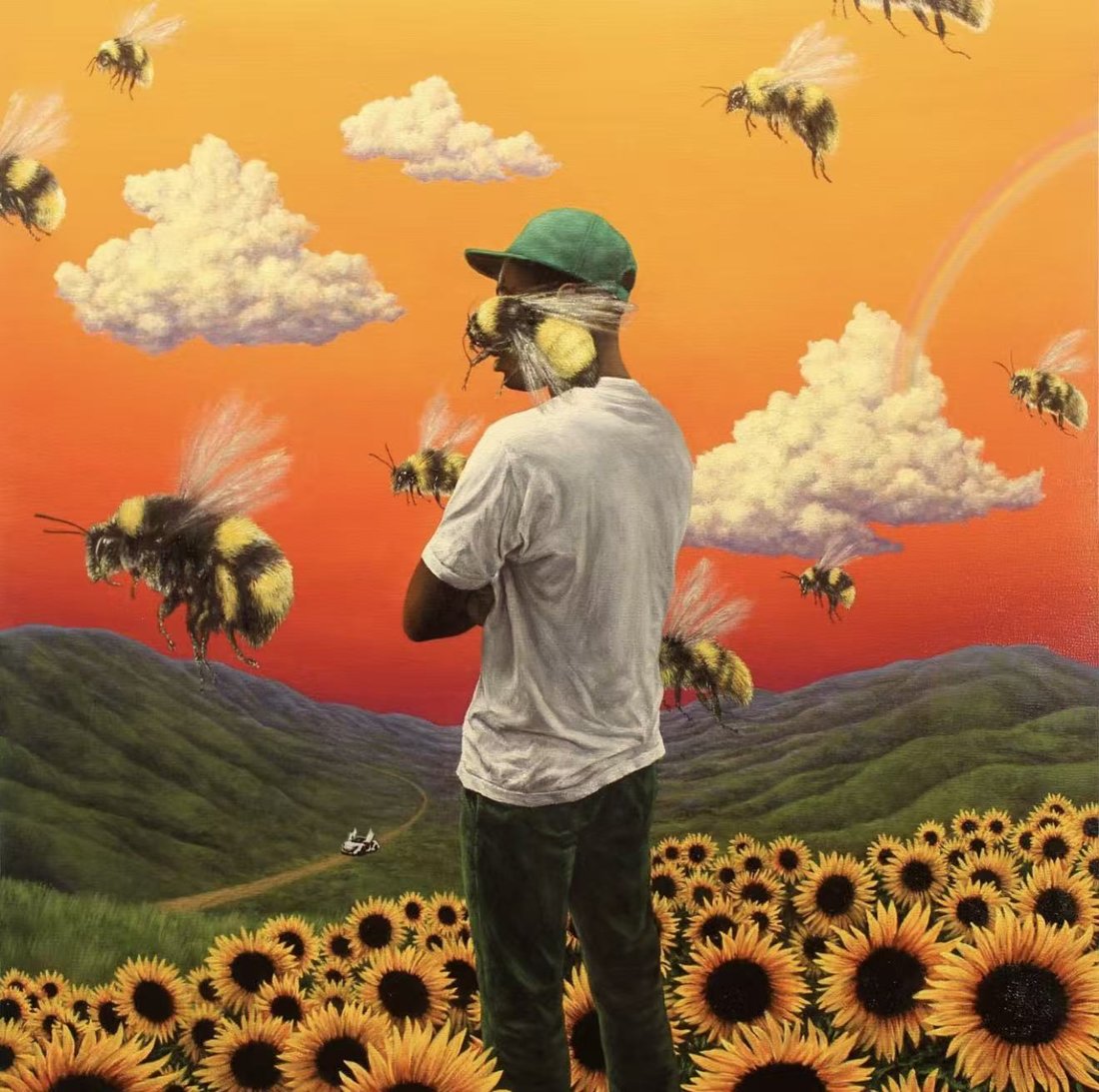
Portrait of Tyler, the Creator Flower Boy album cover
Flower Boy

The person behind the record

A little background.

Tyler, the Creator is the professional name of Tyler Gregory Okonma, born on March 6, 1991, in Hawthorne, California. An American rapper, singer, record producer and fashion designer, he connects his albums with distinctive characters, visual identities and clothing projects.

Tyler helped form Odd Future in 2007 and independently released Bastard in 2009. Goblin (2011), together with the video for Yonkers, brought wider attention to his solo career. Wolf (2013) and Cherry Bomb (2015) expanded his music through jazz, soul and R&B influences.

Flower Boy (2017) includes November, See You Again and 911 / Mr. Lonely. IGOR (2019) and CALL ME IF YOU GET LOST (2021) each won the Grammy for Best Rap Album. Later releases include CHROMAKOPIA (2024) and Don't Tap the Glass (2025), continuing a career that also includes directing videos and founding the Golf Wang and Le Fleur fashion brands.

Biographical background: Wikipedia / Tyler, the Creator ↗

A little context

Finding a voice.

Three useful moments, rather than a complete biography.

  1. Flower Boy

    Released on July 21, the album foregrounds loneliness and longing. November, See You Again, and 911 / Mr. Lonely come from this record and offer three different settings for those subjects.

    Release context ↗
  2. IGOR

    Released on May 17, IGOR pushes singing and synthesizer textures further. EARFQUAKE belongs to this album and provides a useful comparison with the production and vocal roles on Flower Boy.

    Release context ↗
  3. CHROMAKOPIA

    This later album continues Tyler's work as an album-focused writer and producer. Its place in the timeline shows that the Flower Boy songs are one stage in an ongoing creative development.

    Release context ↗

A question to carry into the music

How do the repeated musical setting and the other speakers' memories turn November from a month into an idea of safety or belonging?

The focus track below provides one way into that question. These notes describe audible choices and offer a personal reading, rather than claiming to reveal the artist's private intentions.

Read the focus study →

One song in focus

November

Observation first.
Interpretation second.

An editorial listening study, rather than a statement of the artist's intent.

Flower Boy album cover

FROM THE RECORD

Flower Boy

2017 / Focus track: November

Play November ▷

How do the repeated musical setting and the other speakers' memories turn November from a month into an idea of safety or belonging?

November begins by placing questions and worries inside an inviting musical setting. The repeating accompaniment has a settled quality, but the speaker's thoughts keep moving toward things that could go wrong. I hear a useful tension between those two layers. The music offers a place to rest while the voice keeps checking whether that place, and the life around it, will last.

The recurring reference to November gradually becomes larger than a date. In my reading, it works as shorthand for a time when life felt easier to understand. The return of the hook gives that idea a musical form: the song keeps circling back to a remembered place. Repetition does not recover the past, but it lets the listener feel the strength of the wish to return.

The spoken memories change who gets to define that place. Other voices enter with their own answers, so the song briefly opens beyond Tyler's account. Their different memories suggest that an ideal time cannot be reduced to one shared event. I hear the interlude as a small gathering inside the recording, making nostalgia social even when the surrounding questions remain personal.

Listen again for the moment the spoken voices interrupt the familiar musical flow. The shift in delivery matters as much as the stories themselves: speech sounds less arranged than a hook, even though it has been carefully placed here. For me, the contrast gives the record the feeling of a saved conversation. November becomes somewhere the song can revisit, without pretending that the past can be restored.

On your next listen

  1. The repeated musical setting beneath the anxious questions.
  2. How the hook turns a date into a remembered place.
  3. The change from rapping and singing to several spoken memories.

Factual release context: Album track listing ↗ . The interpretations above are original listening notes.
Three ways in

Start listening.

A small route through the catalogue. Play a track here, follow a listening cue, and return to the detail that caught your ear.

See You Again (feat. Kali Uchis)

Flower Boy / 2017

Play See You Again ▷
Why this song
The clear melodic hook offers an easy first route into Flower Boy. It also introduces the way Tyler gives different voices different roles, allowing a guest singer to expand the emotional space around his own delivery.
Listen for
Listen to the change between Tyler's phrases and Kali Uchis's melodic replies. Then follow the keyboard and larger instrumental gestures. I hear the arrangement making imagined closeness feel almost tangible, while the distance between voices keeps the longing in view.

Release information: Track listing ↗

EARFQUAKE

IGOR / 2019

Play EARFQUAKE ▷
Why this song
A repeated plea and a memorable keyboard figure make this a direct entry into IGOR. Comparing it with See You Again shows how the voice can become one part of a deliberately textured arrangement, rather than sit clearly above everything.
Listen for
Notice the slightly unstable keyboard sound and the way the vocal layers blend with it. The groove remains inviting while the speaker asks someone to stay. I hear the wavering texture as part of that dependence, giving the repeated request a fragile edge.

Release information: Track listing ↗

911 / Mr. Lonely

Flower Boy / 2017

Play 911 / Mr. Lonely ▷
Why this song
Two connected sections make the song a useful introduction to contrast within one track. The inviting first part and more insistent later passage approach loneliness from different angles, letting arrangement become part of the argument.
Listen for
Find the turn between the two sections and compare how the voice occupies each beat. The first part leaves room for melody; the second brings the rap forward more forcefully. To me, the switch exposes a pressure that the earlier groove holds at a distance.

Release information: Track listing ↗

In their own words.

“When people don't allow you to use your voice, you make your own way.”
TIME — Tyler, the Creator and Kenya Barris

In a conversation with Kenya Barris moderated by Raisa Bruner, published August 20, 2020, Tyler reflects on expression and the protests after George Floyd's killing.

“Everyone doesn't realize that they live in a bubble.”
TIME — Tyler, the Creator and Kenya Barris

In the August 20, 2020 conversation, Tyler and Kenya Barris discuss representation and the limits of familiar perspectives.

“I think that's why it's worked for so long, because I found people I can trust”
GQ — Tyler, the Creator, Provocateur of the Year

An exact excerpt from Carrie Battan's November 19, 2019 GQ profile. Tyler credits his lasting working relationship with managers Kelly and Christian Clancy to trust.

“just stay weird and stay tryin’.”
XXL — The Wild and Wonderful World of Tyler, The Creator

An exact short excerpt from the September 27, 2021 interview. Hearing Kendrick Lamar continue to experiment motivates Tyler to keep trying new things.

“I just brush my shoulders off and get back up.”
XXL — The Wild and Wonderful World of Tyler, The Creator

The closing quote of Georgette Cline's September 27, 2021 interview. Tyler describes recovering from mistakes and continuing to pursue ideas.

Curious about another world? Follow the next portrait.

Frank Ocean →

Listening Room